
What is HeartMuLa? The Open-Source AI Music Generator Explained
If you've been looking for a way to create professional music without expensive studio time or subscription fees, you're not alone. The music creation landscape changed dramatically in January 2026 when HeartMuLa launched as the first truly open-source AI music foundation model.
Unlike commercial platforms like Suno that charge $8-30 per month, HeartMuLa gives you unlimited music generation for free. But there's more to this story than just pricing.
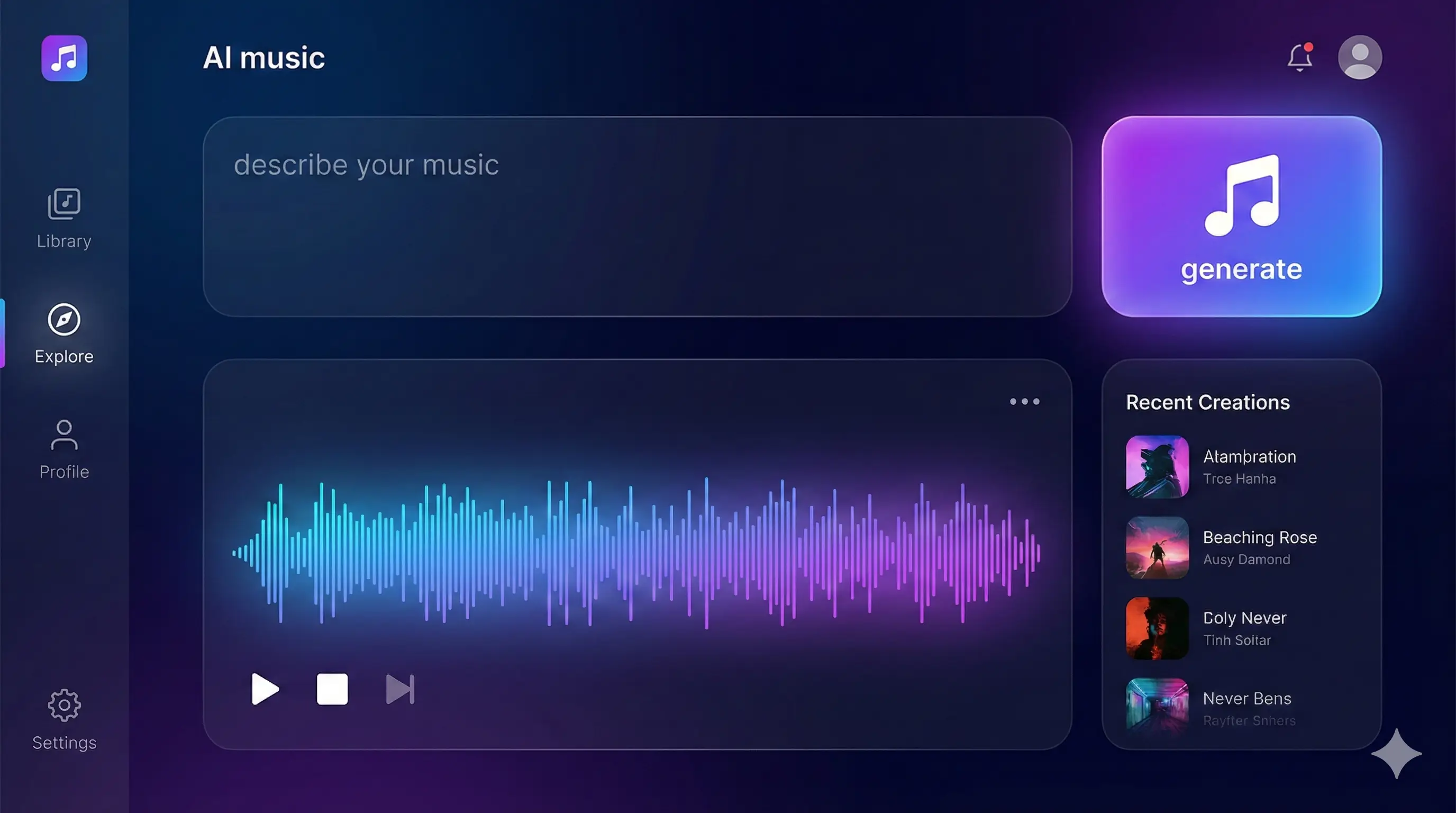
HeartMuLa's web interface makes AI music generation accessible to everyone
The Problem HeartMuLa Solves
Content creators face a constant challenge: finding unique background music that doesn't break the bank or come with copyright headaches. Traditional stock music libraries feel generic, custom compositions cost thousands, and popular AI music tools lock you into monthly subscriptions.
HeartMuLa tackles these issues head-on by offering:
- Zero-cost music generation during beta (and likely beyond)
- Full commercial rights to everything you create
- Complete transparency through open-source code
- Self-hosting capability for privacy-conscious users
How HeartMuLa Actually Works
HeartMuLa isn't just another text-to-music tool. It's a comprehensive music foundation model family built on serious academic research (published as arXiv:2601.10547 on January 15, 2026).
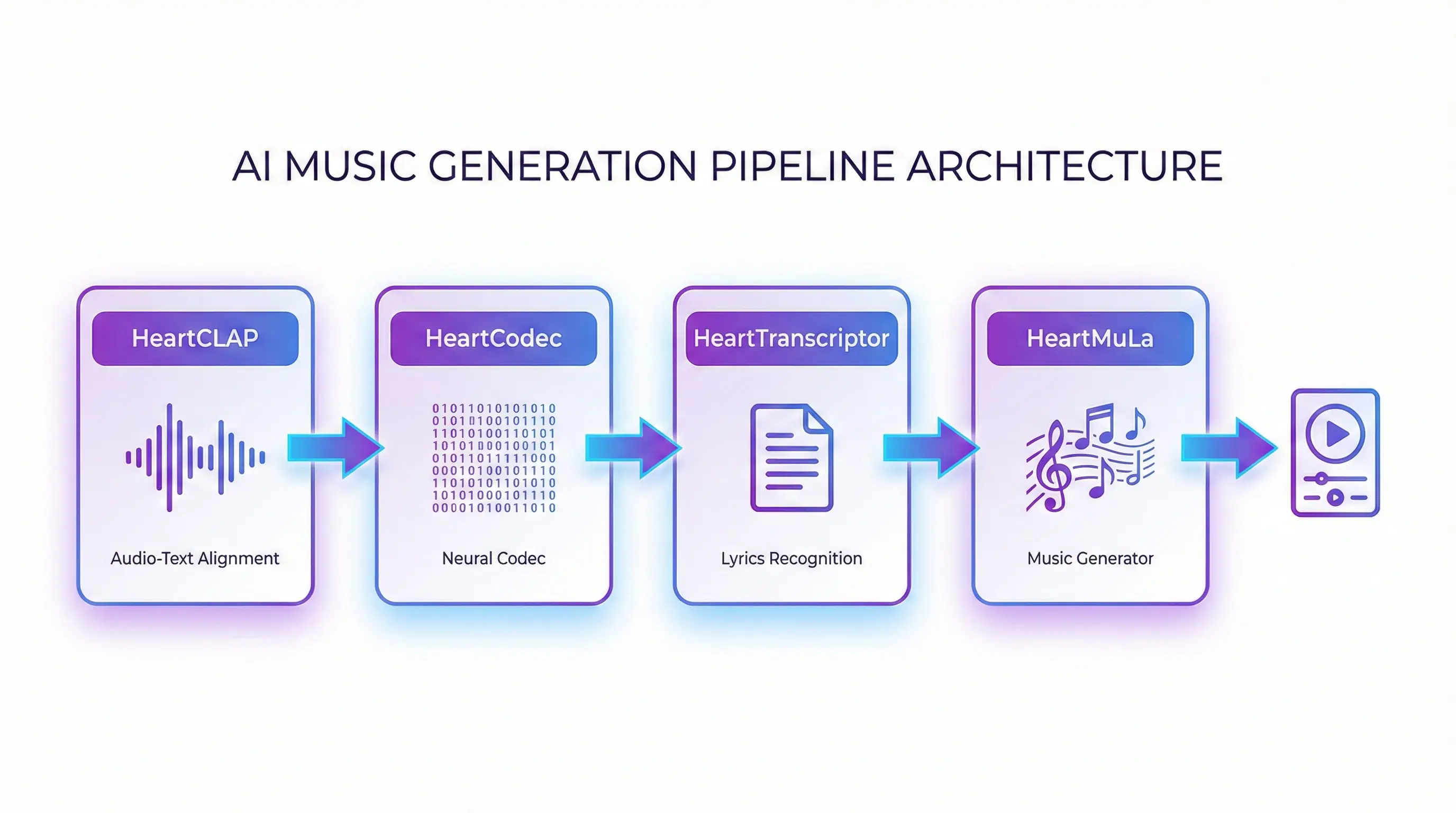
The four core components of HeartMuLa working together to generate music
The system includes four specialized components working together:
1. HeartCLAP: Understanding Music and Language
This audio-text alignment model bridges the gap between what you describe in words and what sounds good musically. Think of it as the translator that understands "upbeat pop with piano" means specific musical characteristics.
2. HeartCodec: High-Quality Audio Compression
Operating at just 12.5 Hz, HeartCodec manages to preserve both the big-picture musical structure and fine acoustic details. This efficient encoding allows HeartMuLa to generate longer tracks without sacrificing quality.
3. HeartTranscriptor: Lyrics That Make Sense
Ever heard AI-generated songs with garbled lyrics? HeartTranscriptor solves this with robust lyric recognition optimized for real-world music. It achieves an impressive 0.09 PER (Phoneme Error Rate) for English—that's clearer than many commercial alternatives.
4. HeartMuLa Core: The Music Generator
The LLM-based generation model synthesizes actual music under your control. You can specify text descriptions, add custom lyrics, or upload reference audio to guide the style.
What Makes HeartMuLa Different
After testing both HeartMuLa and Suno extensively, three differences stand out:
Open Source Transparency: Every line of code is available on GitHub. You can examine exactly how your music gets generated, modify the system, or deploy it locally.
Multi-Language Support: While Suno focuses primarily on English, HeartMuLa handles five languages natively—English, Chinese, Japanese, Korean, and Spanish. Your lyrics sound natural regardless of language.
Reference Audio Input: HeartMuLa accepts reference tracks to guide style. Want your AI music to sound like a specific genre or artist? Upload a reference and let the model learn from it.
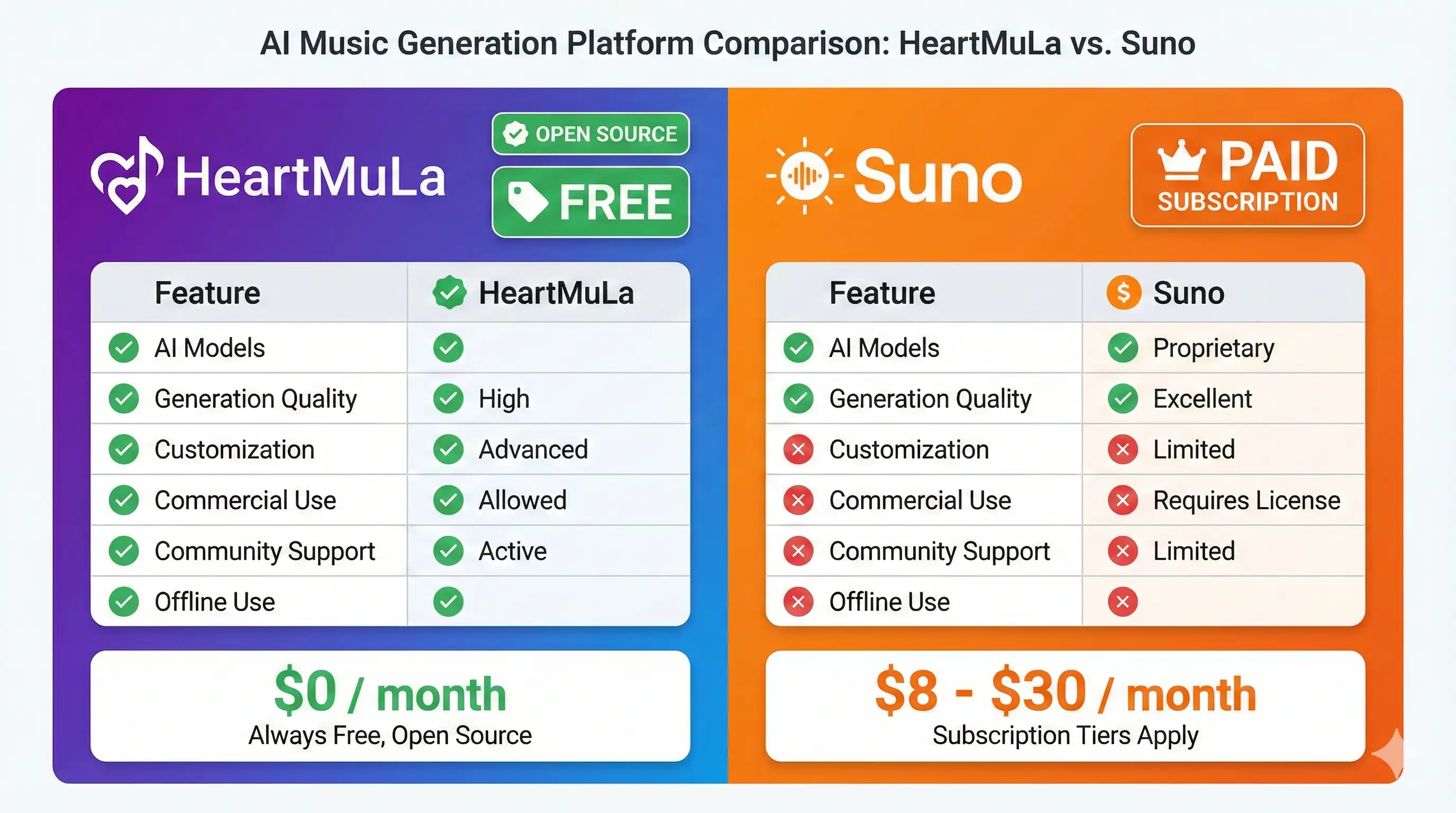
Key differences between HeartMuLa and Suno AI music platforms
Real-World Performance
The research team claims HeartMuLa-7B (their internal version) matches Suno's performance in musicality, fidelity, and controllability. Based on community testing, users report comparable results with the publicly available 3B parameter model.
What's particularly impressive: this level of performance comes from a model trained with academic-scale data and GPU resources. The team proved you don't need massive corporate infrastructure to build commercial-grade music AI.
Two Specialized Modes
HeartMuLa offers flexibility through two distinct generation modes:
Fine-Grained Control Mode: Specify different styles for song sections. Your intro can be soft piano, verses upbeat with drums, and chorus full orchestral—all in one generation request.
Short Video Mode: Creates 10-30 second clips perfect for TikTok, Instagram Reels, or YouTube Shorts. The music fits the rapid pace of social media without feeling rushed.
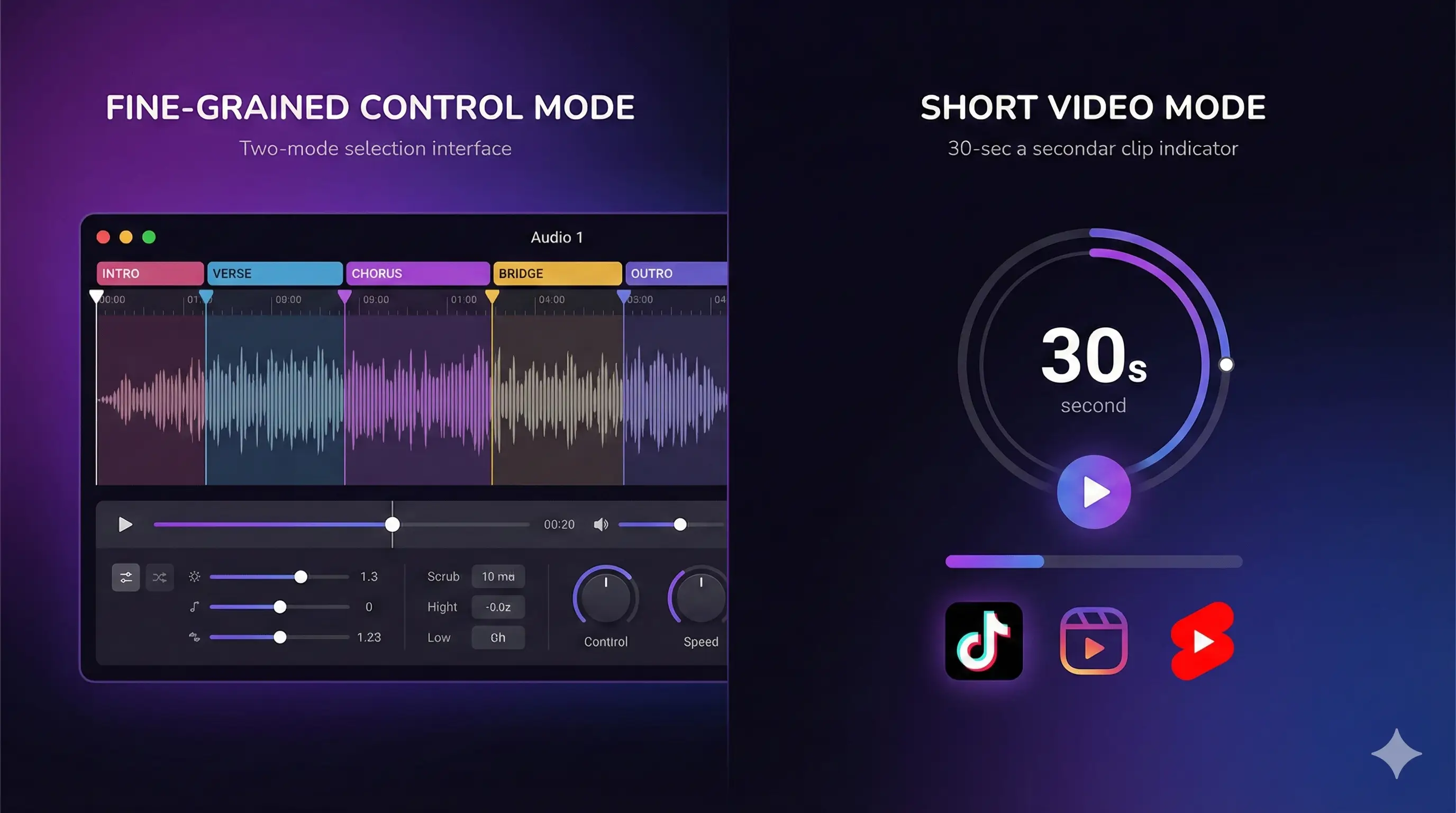
Choose between fine-grained control or short video modes based on your needs
Getting Started with HeartMuLa
The barrier to entry is refreshingly low:
- Visit the official demo to try music generation in your browser
- Clone the GitHub repository for local deployment
- Integrate via API for automated workflows
- Use ComfyUI nodes for visual music generation
No credit card required. No subscription needed. Just describe your music and generate.
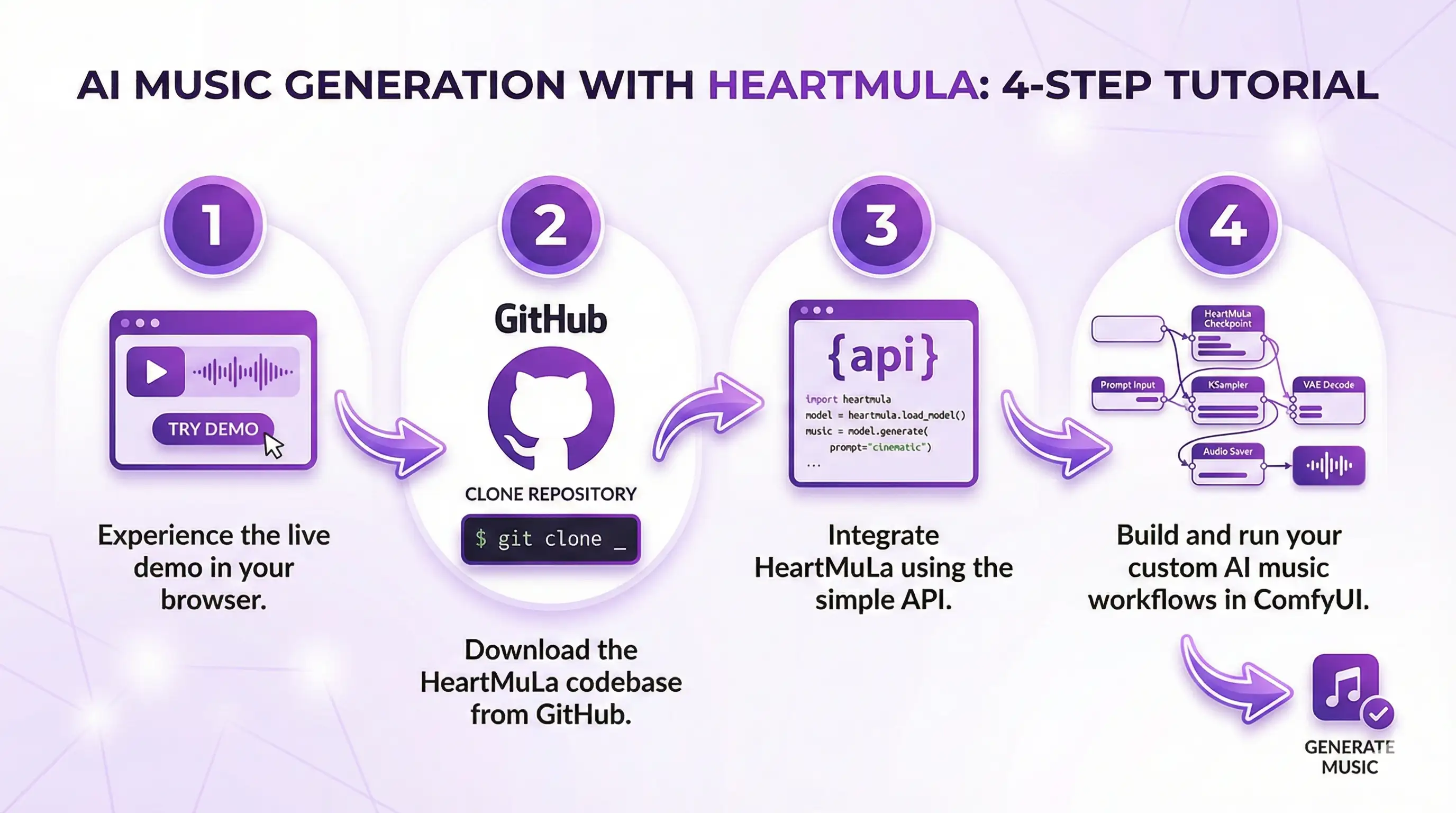
Four simple ways to start generating music with HeartMuLa today
Commercial Use Rights
This matters more than you might think: every track generated with HeartMuLa belongs to you. Use it in YouTube videos, podcasts, games, or commercial advertisements without attribution requirements.
Compare this to Suno's tiered licensing where commercial use requires a Pro or Premier subscription. HeartMuLa removes that barrier entirely.
Privacy Considerations
Self-hosting HeartMuLa means your creative prompts never leave your infrastructure. For creators working on confidential projects or concerned about data privacy, this option provides peace of mind impossible with cloud-only services.
The Apache 2.0 license (updated January 14, 2026) gives you legal certainty about usage rights.

Deploy HeartMuLa on your own infrastructure for complete privacy control
Current Limitations
Honesty matters: HeartMuLa isn't perfect.
- Generation takes 10-30 seconds (faster than Suno's 30-60 seconds, but still not instant)
- The 3B model occasionally produces artifacts in complex arrangements
- Self-hosting requires technical knowledge and GPU resources
- The user interface is functional but less polished than commercial alternatives
These tradeoffs might matter depending on your use case.
The Bigger Picture
HeartMuLa represents something significant in AI music: proof that open-source communities can compete with well-funded commercial platforms. The research paper backing this project (available on arXiv) contributes meaningfully to academic understanding of music generation.
For content creators, indie musicians, and developers, HeartMuLa offers an alternative to subscription lock-in. For researchers, it provides a foundation for further innovation.
Who Should Use HeartMuLa?
This tool makes sense if you:
- Create content regularly and need fresh background music
- Want full control over your creative tools
- Prefer open-source solutions over proprietary platforms
- Need multi-language music generation
- Value privacy and data ownership
- Want to avoid recurring subscription costs
It might not be ideal if you:
- Need the absolute fastest generation possible
- Prefer polished commercial interfaces
- Can't run GPU-intensive applications locally
- Require phone-based mobile apps
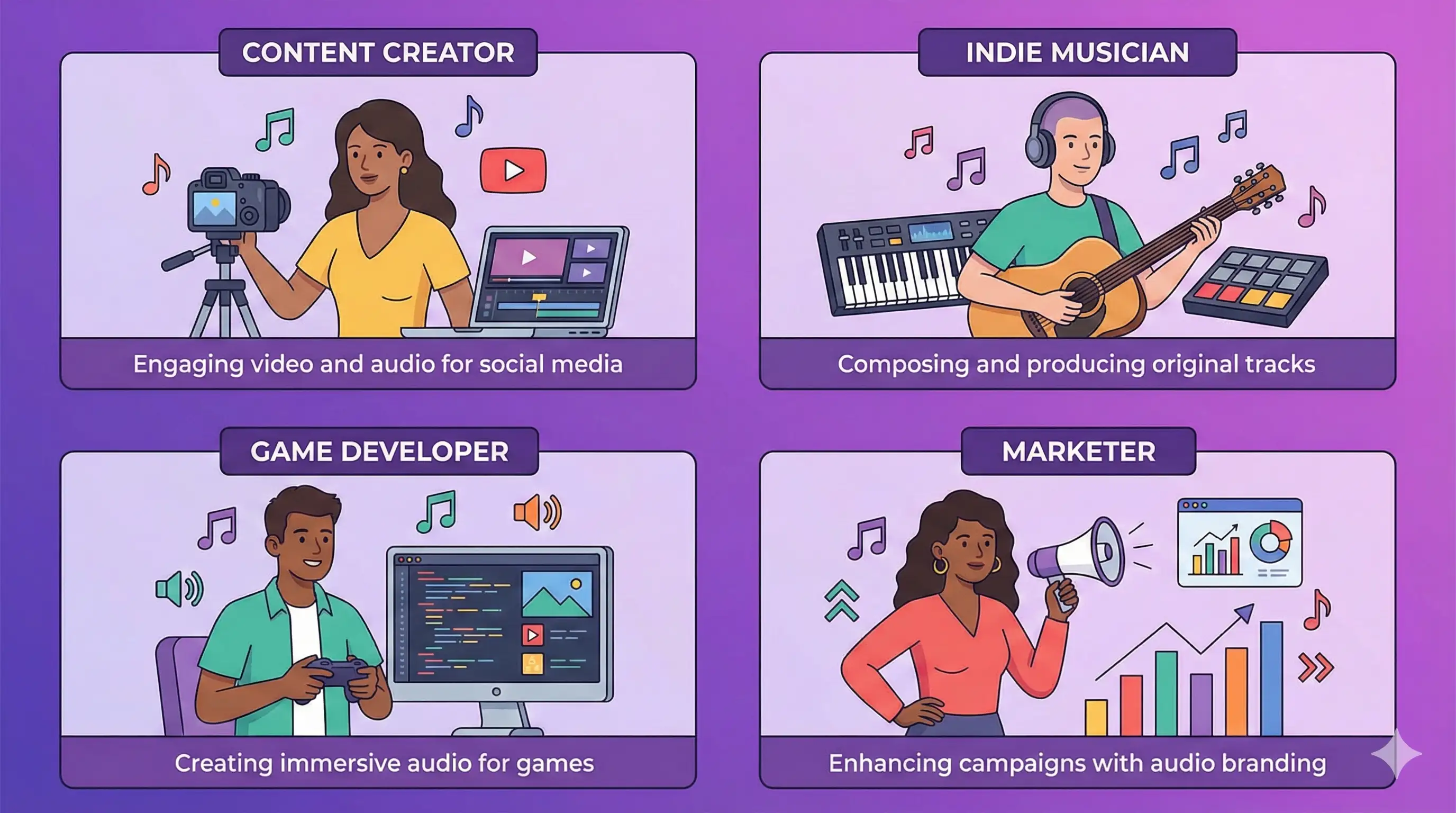
Content creators, musicians, game developers, and marketers all benefit from HeartMuLa
What's Next for HeartMuLa?
The project launched with the 3B parameter model, but the team's internal 7B version shows what's possible with more resources. As community contributions accelerate and the model improves, expect:
- Enhanced audio quality
- Faster generation times
- More language support
- Better style control
- Expanded commercial applications
Final Thoughts
HeartMuLa proves that high-quality AI music generation doesn't require expensive subscriptions or closed systems. Whether you're a YouTube creator needing background tracks, an indie musician exploring new sounds, or a developer building music apps, this open-source foundation model delivers real value.
The combination of zero cost, commercial use rights, and true open-source transparency makes HeartMuLa worth serious consideration for anyone creating music with AI.
Try it yourself at heartmula.github.io or dive into the code on GitHub.

Join thousands of creators using HeartMuLa to bring their musical ideas to life