
HeartMuLa vs Suno: The Complete 2026 Comparison Guide
The AI music generation landscape changed dramatically in early 2026. On one side, Suno released version 5 with studio-quality 44.1 kHz audio and advanced vocal capabilities. On the other, HeartMuLa emerged as the first truly open-source music foundation model that rivals commercial platforms.
If you're choosing between these two powerful tools, this comparison covers everything you need to know about pricing, features, performance, and real-world use cases.
HeartMuLa and Suno represent two different approaches to AI music generation in 2026
The Fundamental Difference: Open Source vs Proprietary
Before diving into specific features, understand the core philosophical difference between these platforms.
HeartMuLa operates under the Apache 2.0 license. Every line of code, model weight, and training methodology is publicly available. You can examine how the system works, modify it for your needs, or deploy it on your own hardware.
Suno remains a proprietary, closed-source platform. The company doesn't publish technical details about their models or training data. You access the service exclusively through their web interface or API, with all processing happening on their servers.
This difference shapes everything else—pricing, control, privacy, and long-term viability.
Pricing: Free Forever vs Subscription Model
The cost difference couldn't be more stark.
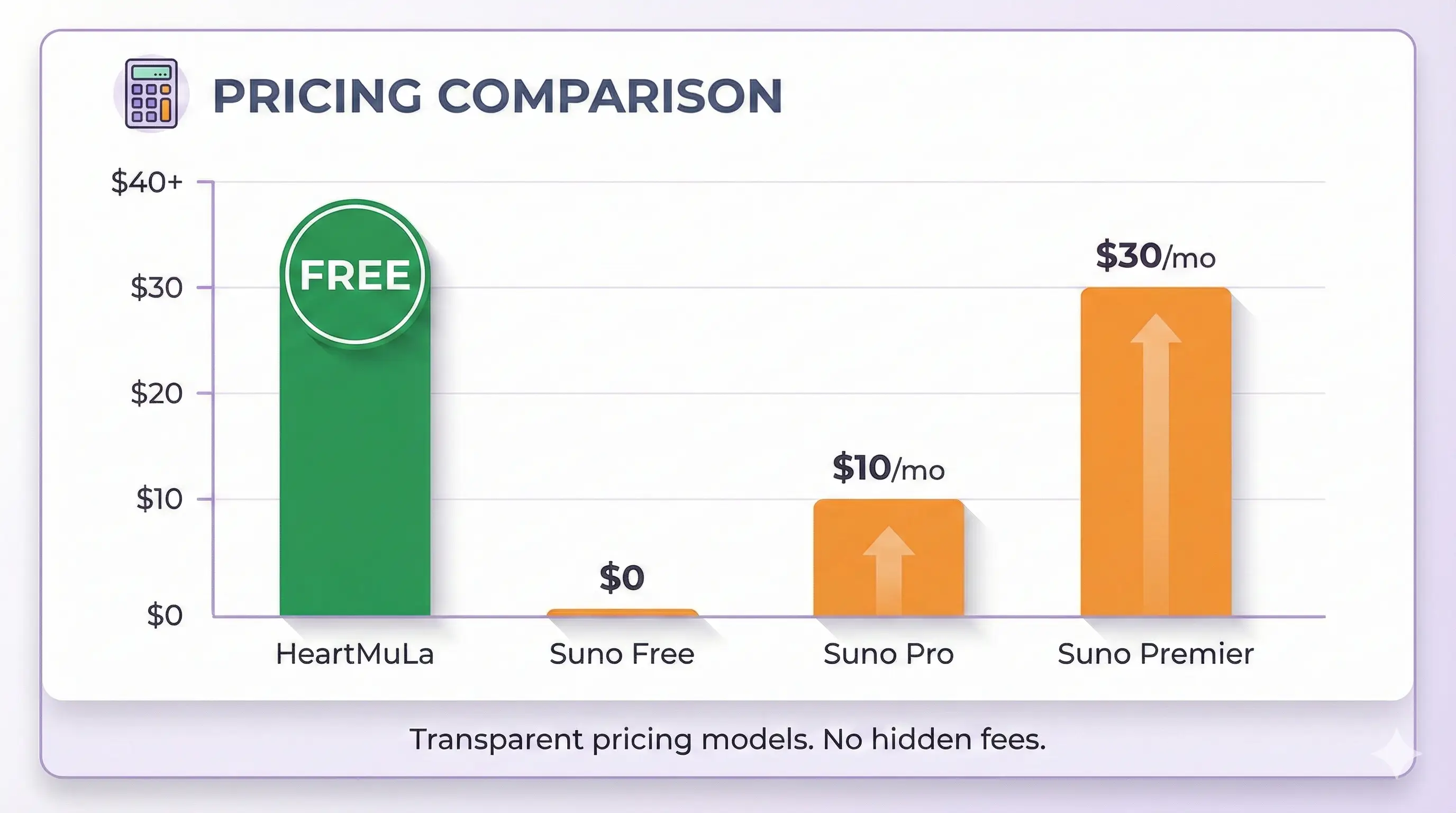
Monthly cost comparison across all tiers
HeartMuLa Pricing
- Cost: $0 (completely free)
- Limits: Unlimited generations during beta
- Commercial use: Included at no cost
- Self-hosting: Free to deploy locally
- Hidden costs: None (though self-hosting requires GPU hardware)
Suno Pricing (2026)
Free Tier
- Cost: $0
- Limits: 50 credits per day
- Commercial use: Not permitted
- Credits refresh: Daily
- Best for: Testing and personal experimentation
Pro Plan
- Cost: $10/month ($96/year with 20% discount)
- Credits: 2,500 per month
- Commercial use: Full licensing included
- Features: Priority generation queue
Premier Plan
- Cost: $30/month ($288/year with 20% discount)
- Credits: 10,000 per month
- Commercial use: Full licensing included
- Features: Highest priority, early access to new features
Cost Analysis: If you generate 100 songs per month commercially, HeartMuLa saves you $120-360 annually compared to Suno's paid plans. Over three years, that's $360-1,080 in subscription fees you keep.
The tradeoff? HeartMuLa requires technical setup and GPU hardware for self-hosting. Suno works immediately in your browser.
Audio Quality and Performance
Both platforms produce impressive results, but they take different technical approaches.
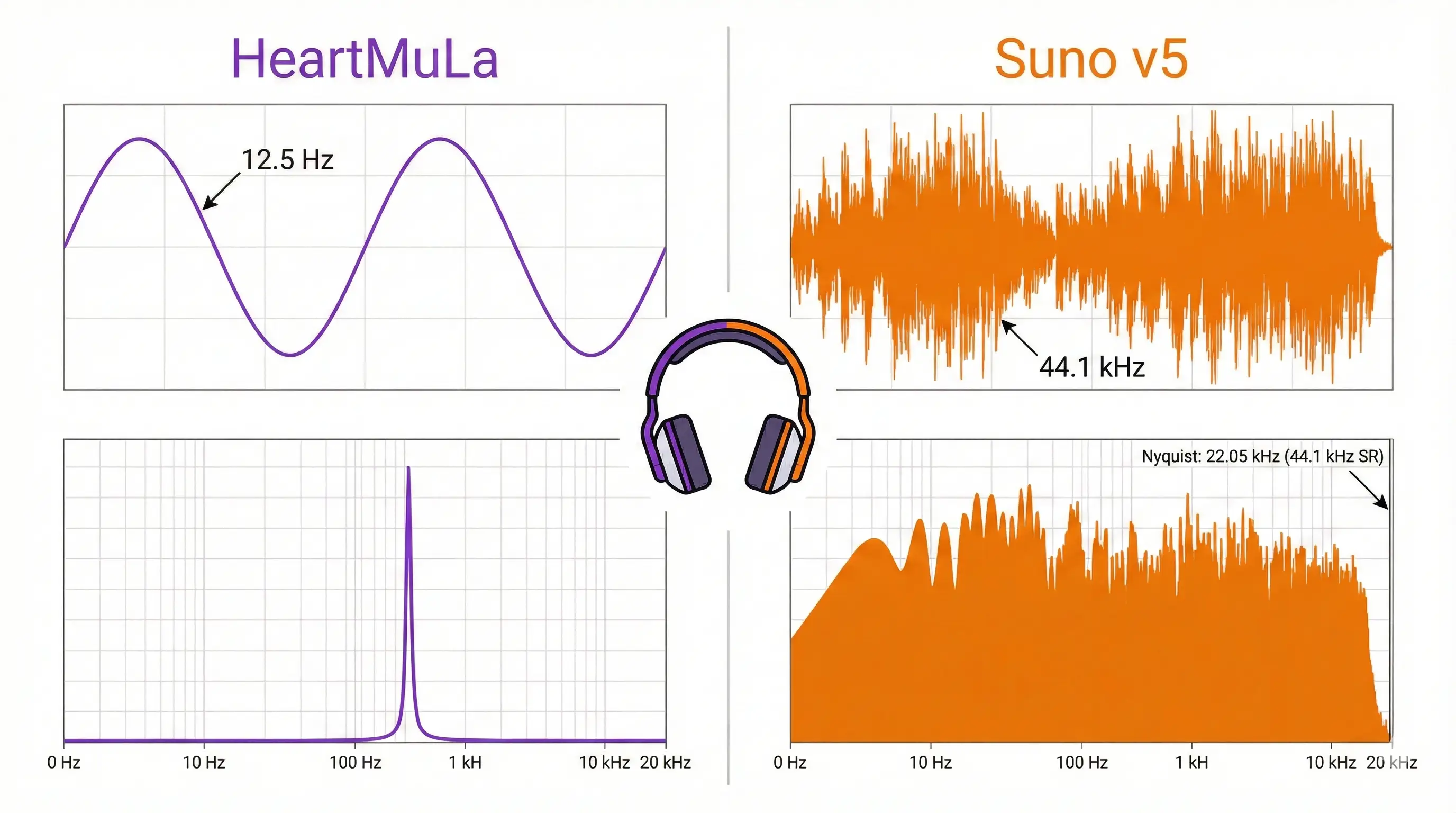
Technical comparison of audio processing methods
Suno v5 Quality Metrics
Suno v5 represents a significant leap from previous versions:
- Sample rate: 44.1 kHz studio-quality audio
- Vocal clarity: Enhanced vocal modeling with clearer pronunciation
- Instrument layering: Richer instrument layers with better separation
- Mixing: Balanced mixing that reduces distortion across genres
- Length: Up to 8 minutes per track (doubled from v4)
Suno v5 handles complex genre mashups particularly well. A track combining "midwest emo" with "neosoul" maintains stylistic coherence while blending distinct musical elements.
HeartMuLa Quality Metrics
HeartMuLa's approach prioritizes efficiency without sacrificing quality:
- Codec: HeartCodec operates at 12.5 Hz (vs typical 25 Hz)
- Lyric intelligibility: PER (Phoneme Error Rate) of 0.09 for English, 0.12 for Chinese
- Overall rating: Mean Opinion Score of 69.93 (second only to Suno-v4.5)
- Performance: Outperforms all other open-source alternatives by significant margins
The research team demonstrated that HeartMuLa-7B (their internal scaled version) matches Suno's performance in musicality, fidelity, and controllability.
Critical finding: HeartMuLa achieves commercial-grade quality using academic-scale data and GPU resources. This proves that world-class music AI doesn't require massive corporate infrastructure.
Real-World Performance Comparison
Based on community testing and the HeartMuLa research paper:
Lyric Clarity Winner: HeartMuLa
- HeartMuLa produces clearer, more intelligible lyrics in both English and Chinese compared to Suno-v5
Generation Speed Winner: HeartMuLa
- HeartMuLa: 73.4 seconds average (after 5.4x optimization)
- Suno: 30-60 seconds depending on server load
Overall Quality Winner: Suno (slight edge)
- Suno-v4.5 edges out HeartMuLa in overall MOS scores
- The difference narrows considerably with HeartMuLa's 7B parameter model
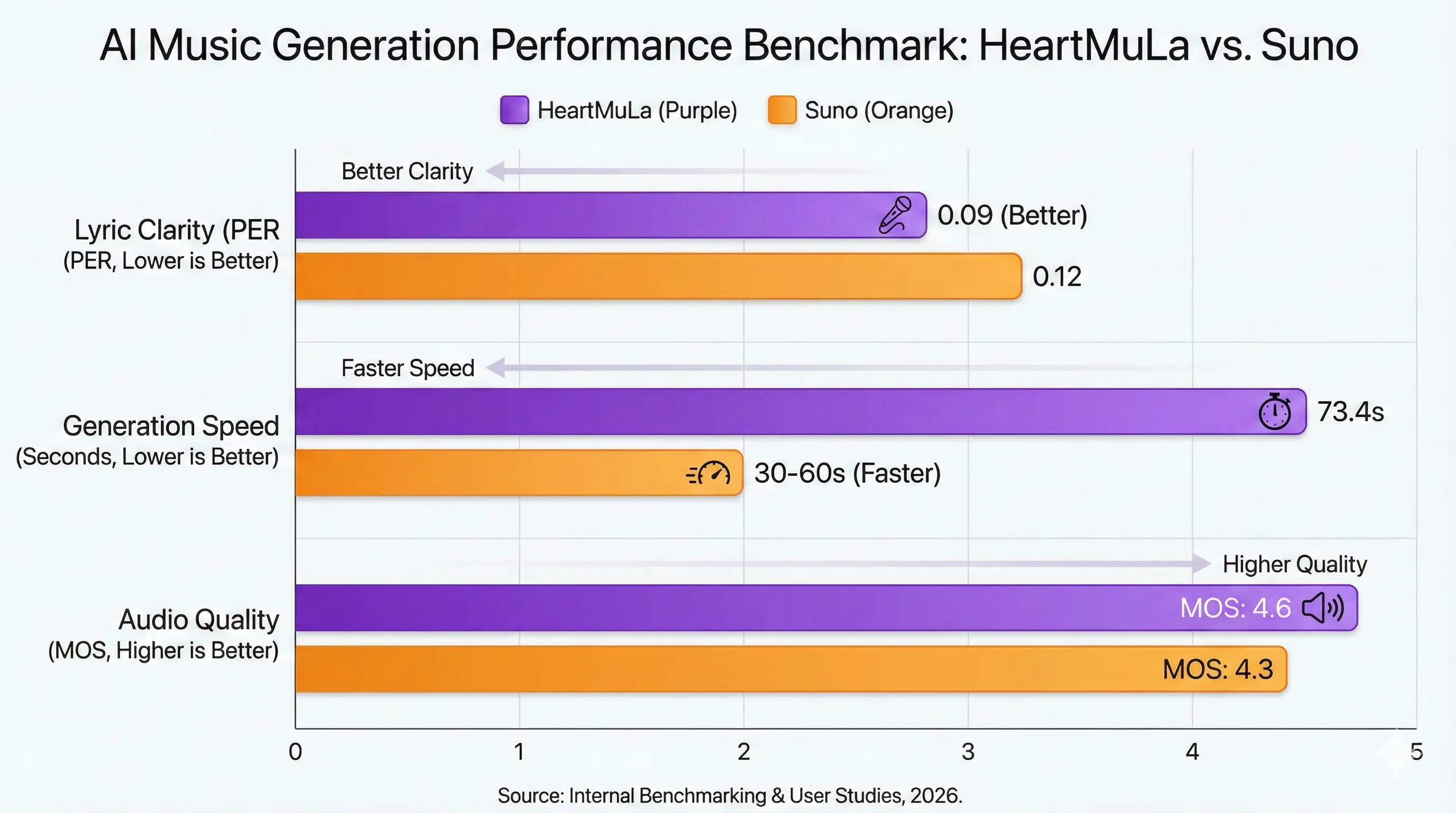
Head-to-head performance metrics across key dimensions
Feature Comparison: What Each Platform Offers
Both platforms pack impressive capabilities, but their feature sets diverge in important ways.
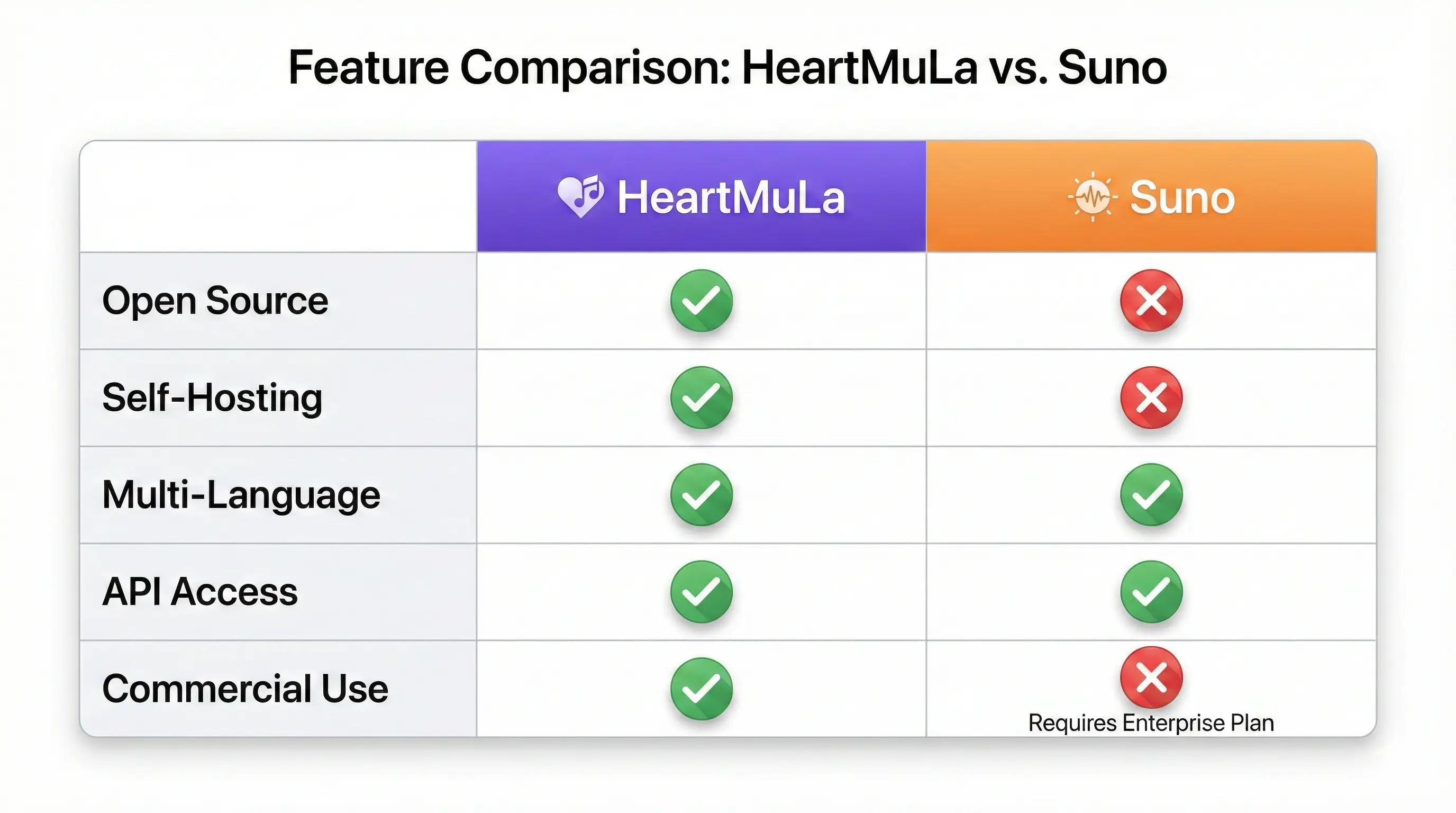
Complete feature-by-feature breakdown
Music Generation Capabilities
Style Control
HeartMuLa: Fine-grained control mode lets you specify different styles for song sections. Your intro can be "soft piano ballad," verses "upbeat with drums," and chorus "full orchestral"—all in one generation request.
Suno: Supports over 1,200 style descriptions with excellent handling of complex genre mashups. The v5 update significantly improved stylistic accuracy.
Custom Lyrics
HeartMuLa: Full control over lyrics with support for five languages (English, Chinese, Japanese, Korean, Spanish). HeartTranscriptor ensures clear pronunciation.
Suno: Custom lyrics supported with strong English pronunciation. Multi-language support is more limited than HeartMuLa.
Reference Audio
HeartMuLa: Accepts reference tracks to guide musical style. Upload an example and the model learns from it.
Suno: v5 introduced "Add Instrumentals" and "Add Vocals" features that allow uploading stems for AI completion. Different approach but similar flexibility.
Specialized Features
HeartMuLa Unique Features:
- Short Video Mode for 10-30 second social media clips
- Complete model transparency (examine exactly how music gets generated)
- ComfyUI integration for visual workflow design
- Self-hosting capability with offline generation
Suno Unique Features:
- DAW-like features following WavTool acquisition
- Vocal replacement technology
- Priority generation queue for paid users
- 8-minute track length (vs HeartMuLa's typical 2-4 minutes)
Language and Accessibility
HeartMuLa:
- Five languages with native support
- Requires technical knowledge for setup
- Works offline once deployed
- GPU required (16GB+ recommended)
Suno:
- Primarily English-focused with some multi-language capability
- Zero technical knowledge required
- Browser-based interface works anywhere
- No local hardware requirements
Use Cases: Which Tool Fits Your Needs?
Your ideal choice depends heavily on your specific use case and technical capabilities.
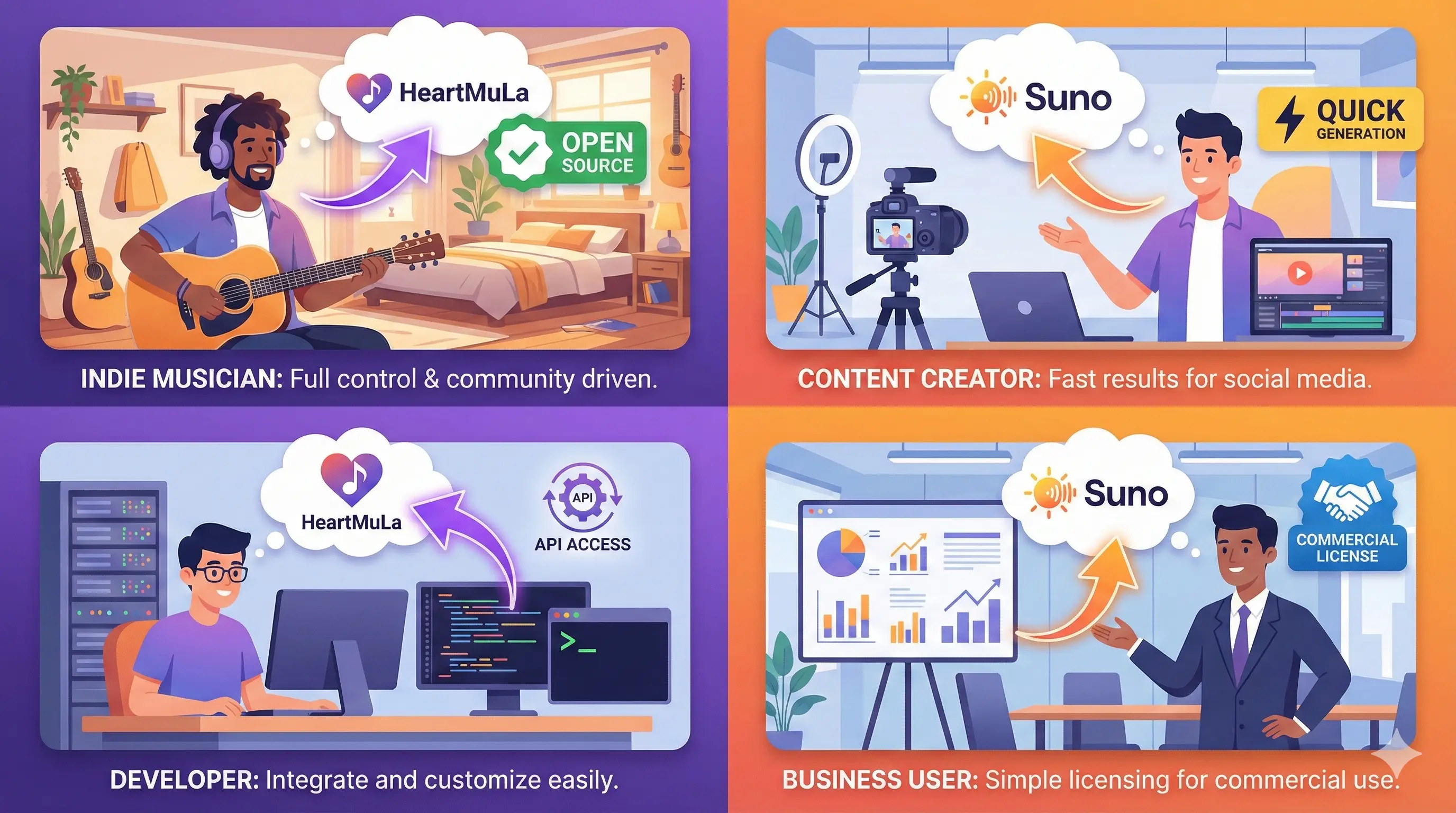
Different user types benefit from each platform's strengths
Choose HeartMuLa If You:
1. Need Complete Data Privacy
Working on confidential commercial projects? HeartMuLa's self-hosting means your creative prompts never leave your infrastructure. Critical for:
- Soundtrack work under NDA
- Proprietary brand music
- Projects with strict data sovereignty requirements
2. Want Zero Ongoing Costs
Generate hundreds of tracks monthly without subscription fees. Ideal for:
- High-volume content creators
- Music production studios
- Indie game developers with tight budgets
3. Require Source Code Access
Modify the system for specialized needs. Perfect for:
- Researchers studying music AI
- Developers building custom music applications
- Companies wanting white-label music generation
4. Value Open Source Philosophy
Support transparent AI development while maintaining full control over your tools.
5. Have Technical Capabilities
Comfortable with Python, Docker, and GPU server management.
Choose Suno If You:
1. Want Immediate Results
No setup, no installation. Generate music in your browser right now. Perfect for:
- Content creators who need music today
- Non-technical users
- Quick prototyping and experimentation
2. Need Maximum Track Length
Suno's 8-minute limit works for:
- Long-form podcast intros
- Extended background music
- Full song compositions
3. Prefer Hands-Off Infrastructure
Don't want to manage servers, GPUs, or software updates. Ideal for:
- Solo creators focused on content, not tech
- Small teams without IT resources
- Users on modest hardware
4. Value Polished UX
Suno's interface provides:
- Intuitive controls
- Professional design
- Mobile accessibility
5. Can Budget for Subscriptions
$10-30/month fits comfortably in your operating costs.
Deployment and Technical Requirements
How you run these platforms differs dramatically.
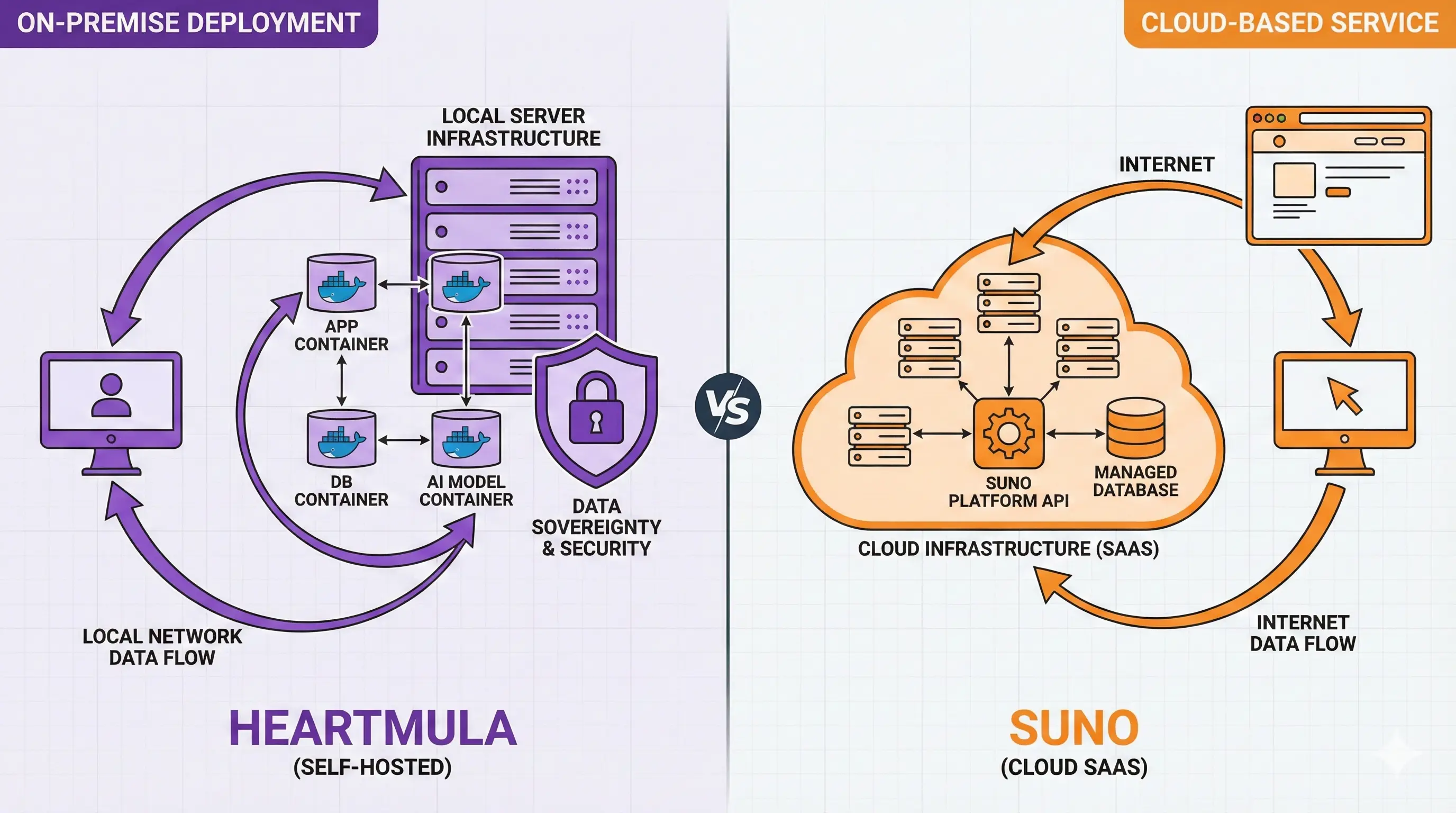
Infrastructure requirements for each platform
HeartMuLa Deployment
Minimum Requirements:
- GPU: 16GB VRAM (NVIDIA recommended)
- RAM: 32GB system memory
- Storage: 50GB for models and dependencies
- OS: Linux, Windows, or macOS with Docker support
Setup Process:
- Clone GitHub repository
- Download model weights (~20GB)
- Install dependencies (Python 3.10+, PyTorch, etc.)
- Configure generation parameters
- Run local server or integrate via API
Optimization: Recent updates reduced generation time from 398.3 seconds to 73.4 seconds through system optimizations. The team achieved 5.4x speedup with memory optimization for BF16 precision on 16GB systems.
ComfyUI Integration: Visual node-based workflow available through community plugins.
Suno Deployment
Requirements:
- Modern web browser
- Stable internet connection
- That's it.
Setup Process:
- Visit suno.com
- Create account
- Start generating
API Access: Available for Pro and Premier subscribers who want programmatic integration.
Commercial Licensing and Rights
Understanding usage rights prevents legal headaches down the road.
HeartMuLa Licensing
- License: Apache 2.0 (model and code)
- Generated content: You own 100% of music you create
- Commercial use: Unlimited, no attribution required
- Modifications: Permitted and encouraged
- Redistribution: Allowed under Apache 2.0 terms
This means you can:
- Use generated music in commercial videos, ads, games
- Sell tracks directly
- Modify the model for proprietary applications
- Incorporate into commercial products
Suno Licensing
- Free tier: Personal use only, no commercial rights
- Pro tier: Full commercial licensing for generated content
- Premier tier: Full commercial licensing for generated content
- Model access: Not permitted (closed source)
Critical distinction: Suno's Free tier prohibits commercial use. HeartMuLa has no such restriction.
Community and Support
Both platforms benefit from active communities, though the nature differs.
HeartMuLa Community
- GitHub: Active development with community contributions
- Discord: Growing community of developers and musicians
- Documentation: Comprehensive technical docs and research papers
- Support: Community-driven through GitHub issues
Strength: Direct access to researchers and core developers. Weakness: Smaller community means fewer tutorials and examples.
Suno Community
- Discord: Large, active community (100,000+ members)
- Documentation: User-friendly guides and video tutorials
- Support: Official customer support for paid users
- Community creations: Extensive library of example outputs
Strength: Massive user base with abundant learning resources. Weakness: Limited direct access to development team.
Current Limitations and Drawbacks
No platform is perfect. Understanding limitations helps set realistic expectations.
HeartMuLa Limitations
Technical Barriers: Setup requires comfort with command-line tools, Docker, and GPU drivers. Not suitable for non-technical users without assistance.
Hardware Requirements: Self-hosting demands serious GPU hardware. Cloud GPU rental adds ongoing costs that may exceed Suno subscriptions.
Track Length: Typically 2-4 minute generations (vs Suno's 8 minutes).
Interface Polish: Functional but less refined than Suno's commercial interface.
Community Size: Smaller ecosystem means fewer third-party tools and tutorials.
Suno Limitations
Subscription Costs: Ongoing monthly fees add up. Premier tier costs $360/year.
No Self-Hosting: Cloud-only means your data goes through their servers.
Closed Source: Can't examine or modify the underlying system.
API Limitations: API access in limited beta, not widely available.
Vendor Lock-In: Migrating away from Suno means rebuilding your workflow.
The Verdict: Which Platform Wins?
There's no universal winner—the "best" choice depends entirely on your priorities.
Choose HeartMuLa if:
- Data privacy matters critically
- You have technical capabilities
- You generate high volumes of music
- You need source code access
- You want zero ongoing costs
- You support open source development
Choose Suno if:
- You want immediate, easy results
- You lack technical expertise
- You prefer hands-off infrastructure
- You need maximum track length
- You value polished user experience
- You're willing to pay for convenience
Consider using both for different scenarios:
- Suno for quick prototypes and experimentation
- HeartMuLa for production music at scale
What's Next: Future Roadmap
Both platforms continue evolving rapidly.
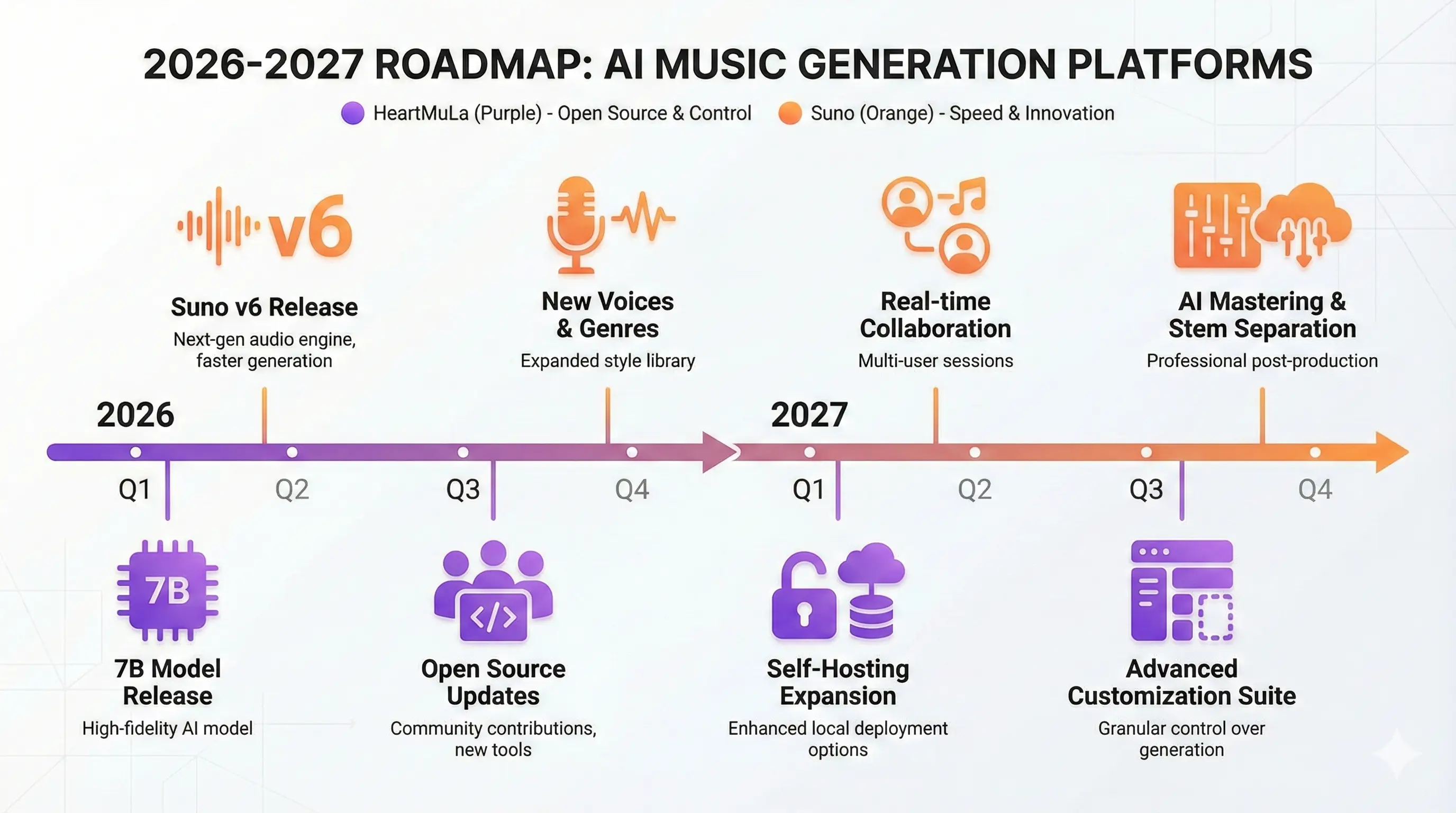
Expected developments for both platforms in 2026-2027
HeartMuLa Roadmap
Based on the research paper and community discussions:
- 7B Model Release: Public release of the larger HeartMuLa-7B model that matches Suno performance
- Extended Length: Improvements to generate longer tracks (6-8 minutes)
- More Languages: Expansion beyond current five languages
- Performance Optimization: Further speedups through algorithmic improvements
- Better Integration: Enhanced ComfyUI nodes and API endpoints
Suno Roadmap
Based on product announcements and version history:
- Suno v6: Expected mid-2026 with further quality improvements
- DAW Features: Deeper integration following WavTool acquisition
- API General Availability: Wider API access beyond limited beta
- Style Expansion: Additional genre and style controls
- Collaboration Tools: Multi-user features for teams
Making Your Decision
Start by answering these questions:
-
Do you have GPU hardware or budget for cloud GPUs?
- Yes → HeartMuLa becomes viable
- No → Suno likely better
-
How many tracks do you generate monthly?
- 10-50 → Either works
- 100+ → HeartMuLa saves money
- 1-10 → Suno Free tier sufficient
-
Is data privacy critical for your work?
- Yes → HeartMuLa required
- No → Either works
-
What's your technical comfort level?
- High → Both options open
- Low → Suno strongly recommended
-
Need commercial licensing?
- Yes + Free tier → HeartMuLa only option
- Yes + Budget → Either works
The good news? You're not locked into one choice. Many users run Suno for rapid iteration and HeartMuLa for production music where volume and privacy matter.
Try Both Platforms
The best way to decide is hands-on experience.
HeartMuLa: Visit heartmula.github.io for the web demo or clone the GitHub repository for local deployment.
Suno: Head to suno.com and start generating immediately with the free tier.
Both platforms push AI music generation forward in different but complementary ways. HeartMuLa proves that open source can match commercial quality, while Suno demonstrates the power of polished, accessible tools.
The competition benefits everyone—creators get more choices, better quality, and lower costs.